
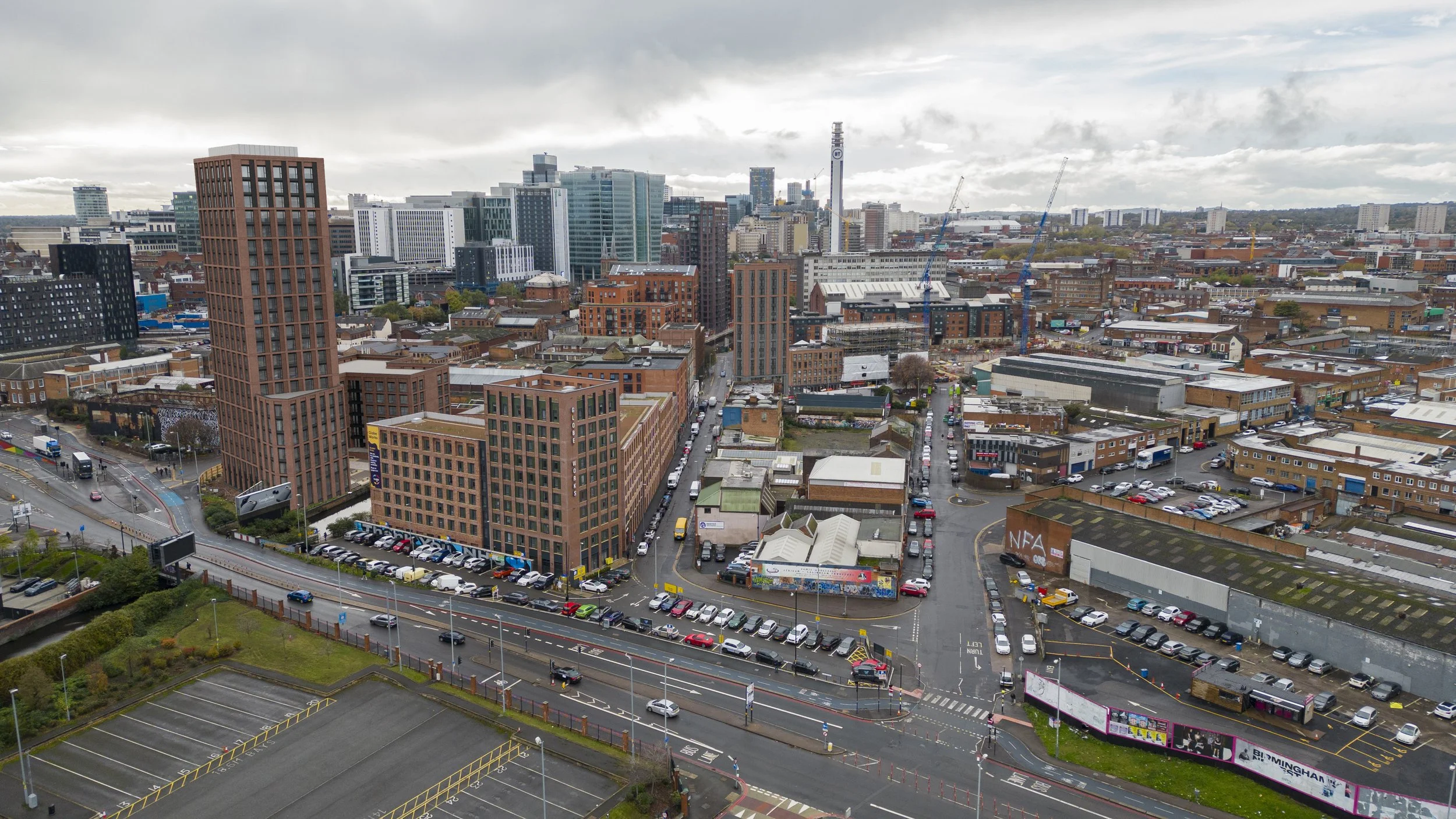
Tall and large-scale buildings require careful Townscape and Visual Impact Assessment (TVIA) and Townscape and Visual Appraisal (TVA) to understand their relationship with existing urban form, skyline character, key views and the experience of people moving through the city. This experience includes a range of major urban development projects where TVIA and TVA work has helped to shape building height, massing, architectural expression and the transition between different townscape contexts.
Relevant projects include Cliveland Street, Birmingham, which comprised the redevelopment of a brownfield site to provide a 220-unit student accommodation scheme, including a 14-storey tower. The TVIA considered the role of the development within Birmingham’s city centre skyline and its relationship with lower-lying suburban areas, helping to inform an appropriate transition in scale and detailing. At 104–112 Hills Road, Cambridge, the assessment formed part of the Environmental Statement for the redevelopment of a prominent gateway site close to the Botanic Garden and the Flying Pig pub, where the proposal sought to transform a poor-quality townscape area through new built form and improved public realm. In Manchester, the Deansgate project involved a TVIA for a 28-storey, 534-bedroom student accommodation building in a sensitive urban location close to the Castlefield Conservation Area and listed buildings, requiring detailed consideration of skyline effects, heritage setting and the contribution of a new landmark building to the cityscape.
Further TVA and TVIA experience includes Saxon Court, Milton Keynes, a proposal for one of the tallest new buildings in the city at circa 29 storeys; the redevelopment of the Beehive Centre in Cambridge, involving substantial new commercial buildings of considerable height; and mixed-use regeneration proposals in Derby at Bradshaw Way Retail Park and The Eagle Quarter. Across these projects, the townscape and visual work has focused on balancing development ambition with contextual sensitivity, ensuring that tall and large-scale buildings are assessed not only in terms of visibility, but also in relation to urban structure, townscape character, public realm quality, skyline composition and the creation of successful new places.